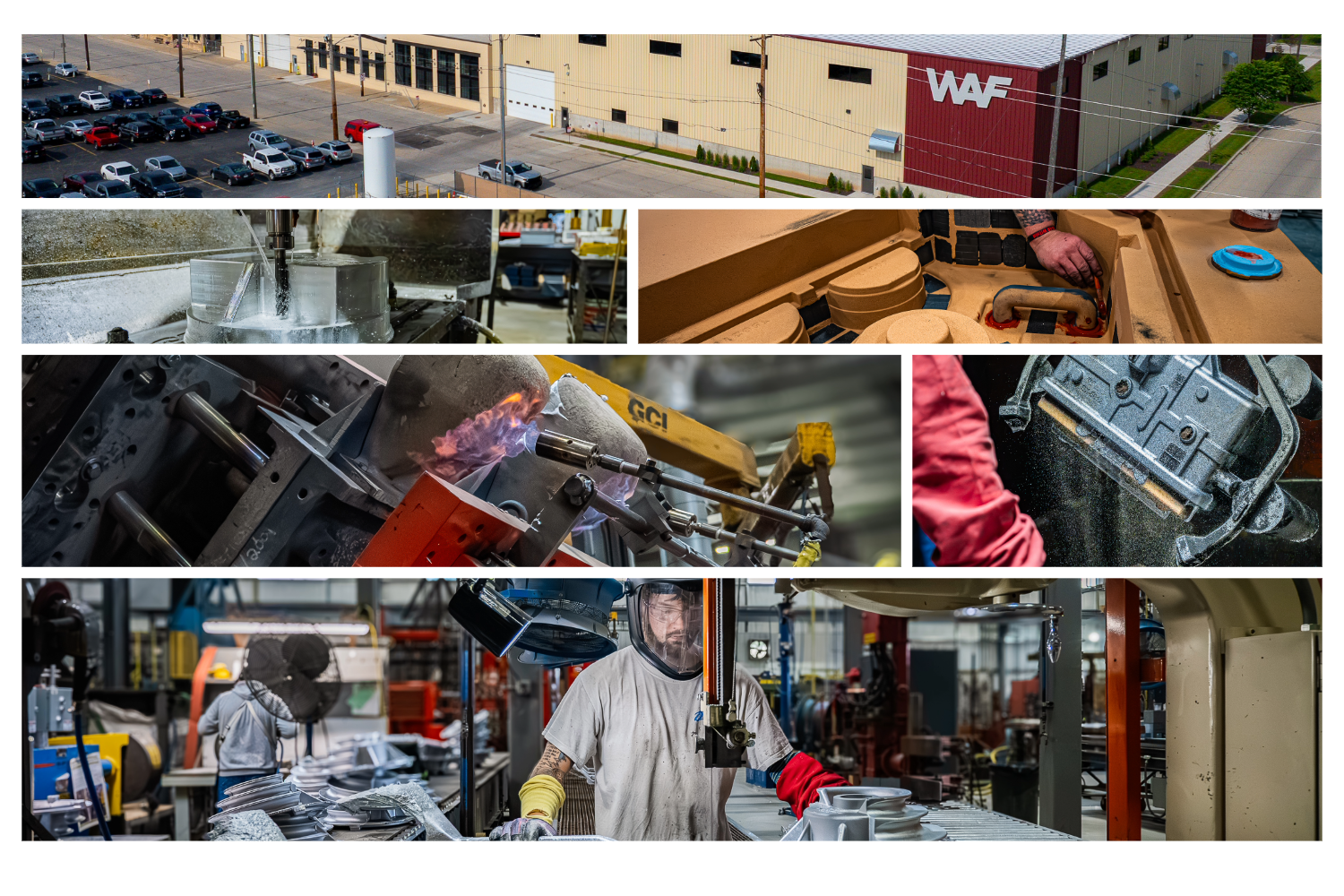
The Wisconsin Aluminum Foundry in Manitowoc was not built for art. It was built for production — for the kind of precision components that end up inside machines, vehicles, and defense systems. The workforce there shapes molten metal into any geometry imaginable, then machines it to spec. They move fast, with professional focus, and they don't stop for just anyone.
Until now.
For the better part of a year, I was the strange presence in the background of a working foundry, an artist in a place not designed for artists, making a large-scale sculpture inspired by ancient Chinese history, Buddhist philosophy, and an obsession with the nature of perception itself.
I didn't know if it would work. There were moments I was almost certain it wouldn't.
Where It Started
The project began during a low point. I had stopped making stylized motorcycle engine castings as my primary income, and the years of hard-won self-sufficiency I'd built around my creative work had quietly run dry. I found myself without a clear path forward, aware that significant changes were coming whether I was ready or not.
It was in that uncertainty that the idea took shape. I needed to understand what had happened, not as an exercise in regret, but as a way of mapping the pitfalls clearly enough to avoid them next time. If those years of making motorcycle covers never generated lasting economic value, I could at least take the technical skills I'd earned and channel them into something that might help me understand who I am. That would be worth something, for me, and perhaps for others navigating their own version of the same uncertainty.
This became the seed of something larger: a prototype for an art residency, a program built on the belief that artists embedded in working industrial environments, alongside skilled tradespeople, can produce something that neither could alone. The sculpture was the first test of that idea. And this is the story of what it taught me.
The decision to make a metal mirror was, on the surface, straightforward. A polished metal surface reflects light, and in doing so, reflects you back to yourself. That was exactly what I needed, not a flattering version, not a convenient one, but an honest image that held both my failures and my successes in full view. The mirror was a deliberate act, a way of finding clarity, breaking old cycles, and growing into a new way of living.

Research Phase
With the concept locked in, I reached out to the Field Museum in Chicago, which houses an extensive collection of antique metal mirrors from across Asia. Collection manager Jamie Kelly walked me through over 200 of them. I was ready to learn about something beyond carbureted engines and online commerce.
I had already been researching TLV mirrors, ancient Chinese bronze mirrors from the Han Dynasty, named for the T, L, and V shapes recurring on their decorated backs. That research led me to Berthold Laufer, a Field Museum curator who was almost single-handedly responsible for acquiring many of these objects during a period of profound political upheaval in China, a moment when a significant piece of that culture's past was at genuine risk of disappearing.

Laufer recognized that imperial China in the 1890s was on the verge of collapse. Over two expeditions in the early 1900s, he traveled alone through a country in open conflict, moving through warring regions with a single donkey cart, acquiring artifacts directly from locals, carrying them back to be preserved. Many of those objects, likely protected from destruction during the Cultural Revolution fifty years later, eventually found a home in institutions like the Field Museum.
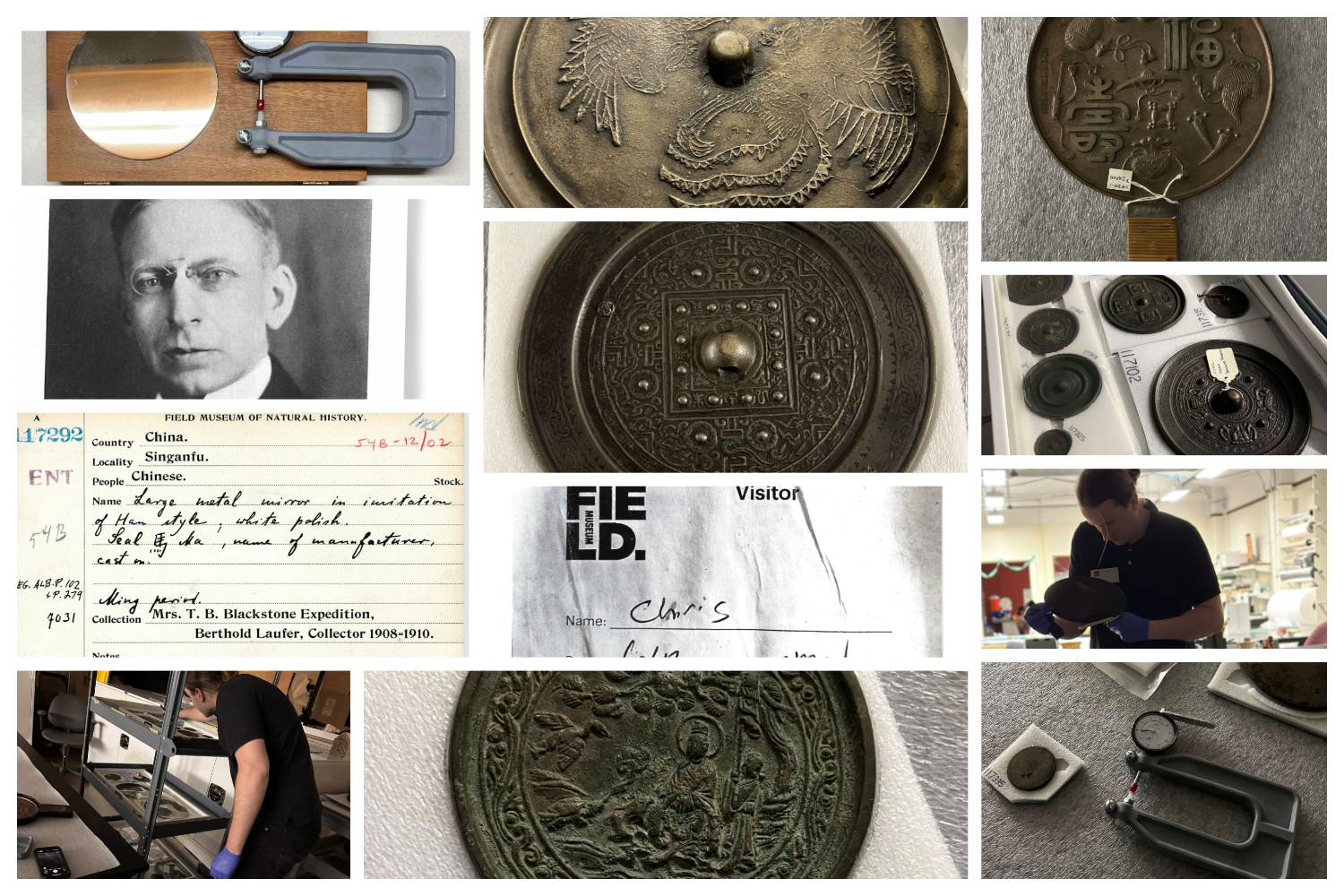
And there I was, standing in front of them, trying to read the decorative language pressed into the backs of those castings.
The iconography isn't decorative in any modern sense — it's cosmological. Cardinal directions divide the night sky into quadrants, each defined by animal constellations that mark the seasons, transforming the heavens into a clock tracking time itself. A relationship between earth and sky, rendered through centuries of careful observation. Depictions of the cosmos from ancient Han Chinese, to track cycles, recognize patterns, and remain observant to what is larger than yourself. If you could track the sun and stars, you knew when to plant, when to prepare, and when to rest. That knowledge was considered important enough to emboss onto the back of what was also an optical tool.
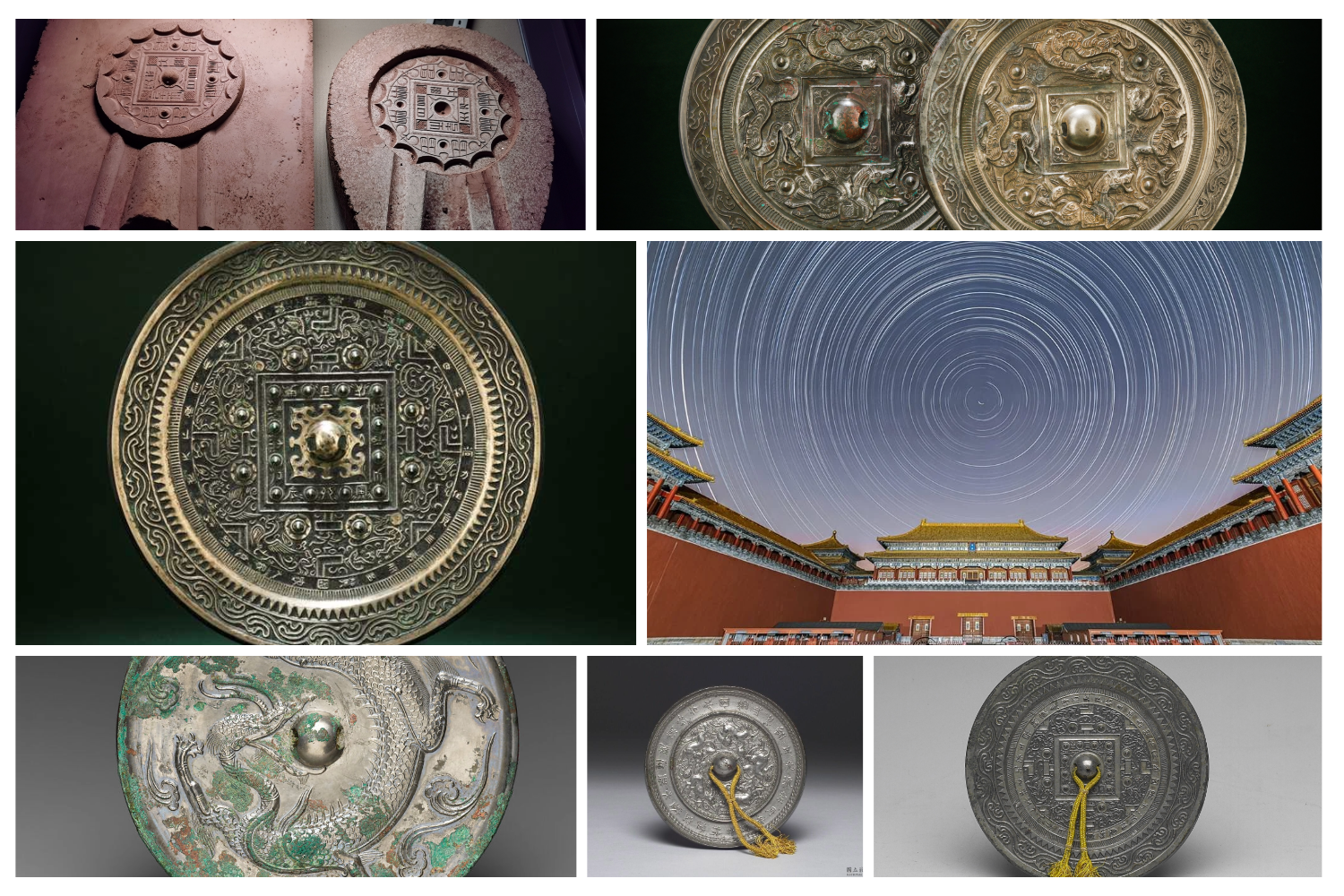
The other side, the mirror surface, was polished bronze, ground and finished until it could return a near-perfect reflection. In a world where that kind of clarity must have been a rare and remarkable thing, it was built with a single purpose: to let you see yourself.
Together, the two sides carry a complete idea. Understand the world around you. Understand yourself. That entire philosophy, embossed into a cast object sometimes no larger than two inches across.
That was the moment I realized this was no longer going to be an ordinary art project. The radial geometry on the backs of those TLV mirrors bore a striking resemblance to Buddhist sand mandalas, and I took that as my next clue.

I visited a Tibetan temple in Madison to watch monks build one. Beginning at the center and working outward, they laid intricate patterns of colored sand using no tools, only ritual knowledge and devotion. Each gesture deliberate, each mark meaningful. The whole thing radiated patience. When finished, the mandala would be swept away and offered to water, a blessing to the universe and a symbol of the journey from ignorance to enlightenment.
Standing there, I understood something I hadn't before: human creativity is a powerful alchemy. The ancient mirrors taught me the power of perspective and pattern recognition, both internal and external, and the monks gave me an example of abstract personal transformation through meditative craft. The ability to turn any experience, good or bad, into new, valuable perspectives for others is central to humanity, and I believe this trait is either an evolutionary miracle or evidence of a higher power.
I could see that my own transition had already begun. I felt as if my subconscious had drawn me to these new perspectives and themes of transformation, and like the monks making blessings from craft, I intended to do the same with the foundry sand.
The Foundry
Making this piece inside an active aluminum foundry meant working within constraints no prior experience could have prepared me for. Forklifts moving constantly. Molds the size of cars hanging from gantry cranes. Something happening around every corner.
To say I was overwhelmed would be an understatement. I had to learn quickly how to work around and alongside others in a space where every inch seemed claimed by either a person or a machine. An earlier version of me would have grown frustrated. But I had accepted the challenge, and after hearing Laufer's story, I didn't have much to complain about.

The people in the foundry were generous and welcoming. Wyatt, who I befriended early on in the pattern shop, became an essential partner, helping design and shape the mirror's frame segments, sharing a standard of craft that made him not only a collaborator but a trusted friend. We built mold boxes from plywood with casters on the bottom so even the largest could be moved by one person. I learned from Aaron and Jersey how to work with air-set sand and operate the overhead cranes. Robert and Mark handled the pours. Cory welded the parts together in the shop.

Throughout it all, I leaned on a workforce generous enough to share what they knew. Those people, John King, Aaron, Wyatt, Cory, Robert, Mark, Jersey, and others, carry a depth of knowledge so thoroughly internalized it reads as instinct. You could feel how long certain understanding had taken to accumulate, decades folded into offhand observations. It reminded me of monks deep in meditative practice, so present in their work they know every grain of sand.
I wanted what I made to honor that. Not just to use the foundry as a backdrop, but to genuinely be of it. None of this happens alone.
This is the heart of what an art residency can offer, and why this project became its proof of concept. What happened in that foundry wasn't just the making of a sculpture. It was a demonstration of what becomes possible when artists and skilled tradespeople share the same floor. The machinists and molders brought technical mastery that no art school teaches. I brought a set of questions, a design sensibility, and a willingness to be a student. What resulted was something neither of us would have made independently. That exchange, of knowledge, craft, and perspective, is exactly what a residency is built to cultivate.
The goal is to open that exchange to others. Artists embedded in working industrial environments, learning from people whose expertise lives in their hands, create work that is grounded, rigorous, and deeply human. The tradespeople gain something too: the rare experience of watching their knowledge become the raw material for something beyond the functional. Both leave changed. The community gains something it can see, touch, and think about. This is the kind of program worth investing in, not because art is a luxury, but because this model of collaboration produces people who are more capable, more connected, and more creative.

The Piece Finished
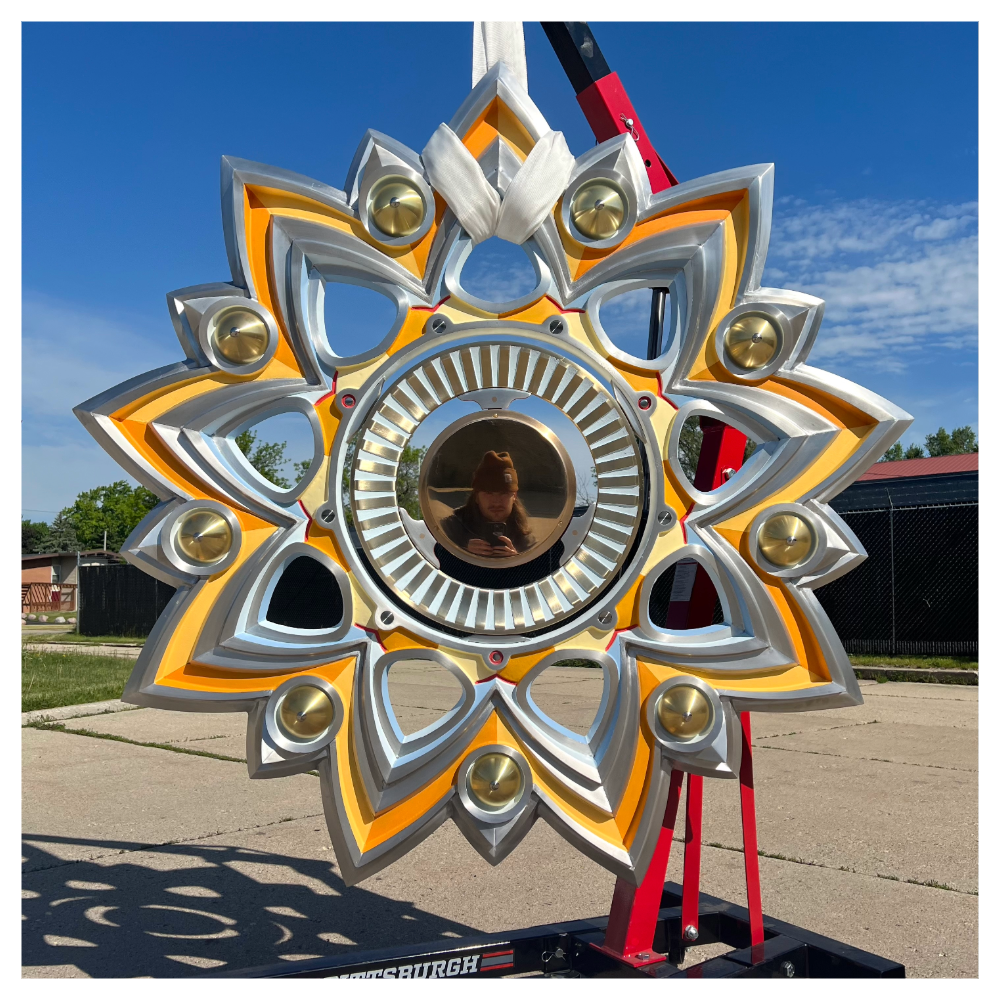
The large cast metal mandala I built is a visual record of learning how to know myself and finding a new way to live. The design is mine, but it doesn't have to stay that way. It can be anyone's self-portrait, an open invitation to the kind of inward journey that doesn't end.
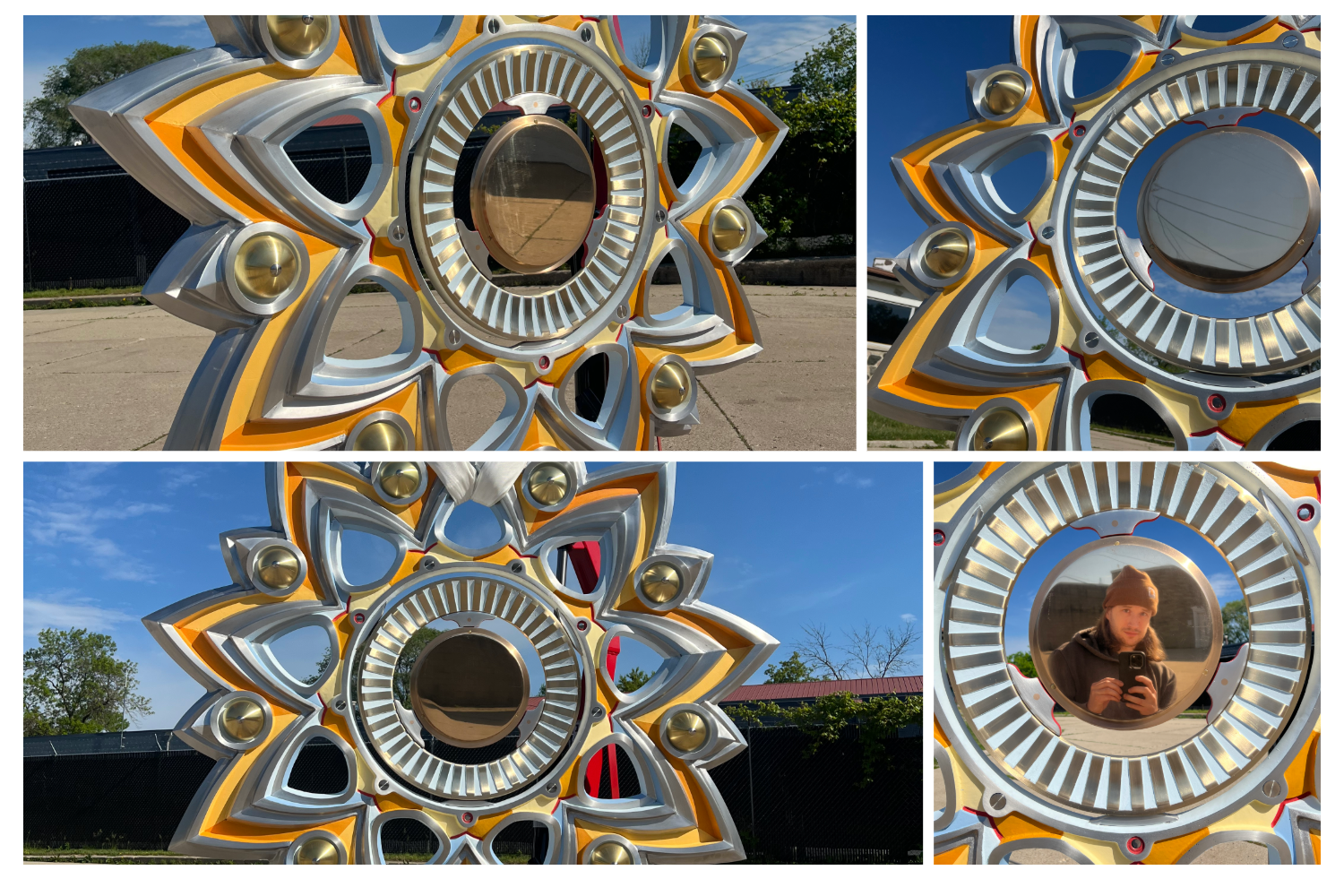
The frame is a single sculptural motif, replicated nine times, drawn with the arcs of my own forearms, left and right. Roughly five feet in diameter, it's made of cast aluminum, stainless steel, and aluminum bronze, with a polished red brass mirror at its center. The radial geometry draws from TLV mirror iconography, the petal forms echo Tang Dynasty mirrors and Buddhist sand mandalas, and the brass hemispherical domes along the outer ring are hand-sanded to a finish that catches light the way sun hits open water. Like a monk working outward from a center point, I rebuilt from the inside out, reordering priorities, confronting the patterns that had been quietly steering my life without my full awareness.
What had brought me to such a low point was this: I had taken my cues from modern expectations. I moved fast, worked long hours, and optimized for output. That mode served me well for a long time, but it's a framework built around commerce, and at some point I collected problems it couldn't solve. They were spiritual and human ones, the result of years spent building a brand at the expense of everything else. I wanted so strongly to create my own economic independence that I traded away my time, and with it my humanity, in pursuit of it. And even after such a costly bargain, I still missed the goal of deveoping lasting economic stability.

I think the part of me that wanted to visit the Field Museum and learn from monks was my subconscious proposing a correction. What I needed was to slow down, to engage in the kinds of pursuits that develop my humanity and keep me whole. Make art. Learn about lost cultures. Practice writing. Whatever form of soulfulness keeps me present and ready for what's next.
Most of us need more of that. We need to develop our creativity and curiosity, and take seriously what the subconscious is reaching toward, even when it leads somewhere that doesn't fit neatly into a career or a brand. The problem is we're doing it less and less, partly because we're busier than ever, and partly because something has rushed in to fill that space. Tech platforms, algorithmic feeds, tribal politics, all of it extraordinarily good at simulating meaning without delivering any. The real thing is slower. It asks more of you. But it's those moments that actually change you.
The mirror at the center allows the viewer to literally see themselves inside the mandala. But look closely at the edges and you'll notice distortion. That's intentional. Our self-perception is shaped and often warped by the experiences we carry. The past has a way of changing the future before it arrives, and we need to be more aware of that if we wish to have better results in our future.

For thousands of years, humans have undertaken journeys like this one. In the modern world, a spirit journey is too often dismissed as something fringe rather than recognized for what it truly is: a practice of reclaiming your humanity. An art residency is a structure for that practice, a protected space where slowing down is the point, where learning from others is the method, and where the work that results belongs to the whole community.
What I made in that foundry was proof that this kind of exchange is possible, and that it produces something real. We're building a program around it now, one that opens that experience to artists, makers, and the broader public. One that puts people back in rooms together, making things by hand, learning from each other across disciplines, and contributing something lasting to the places they inhabit.
Look for new reasons why you are here. Look beyond the metrics of modern life, beyond capital and materialism, beyond power or status, and open yourself to perspectives that unsettle and expand you. Seek out experiences that sit outside your norm, take what is useful, and share it with others.
This piece is an invitation to begin your own journey, to look at everything differently. To examine what drives you, where you find joy, and what you have been avoiding. A spirit journey compressed into geometry: a psychic map cast in metal and left in the world for anyone willing to see themselves differently within it.